Tape Ball Cricket Pitch Dimensions: Complete Guide to Length, Width and Ground Setup
If you are setting up a tape ball cricket match, one of the first things you need to decide is the size of the pitch. The right measurements can make a big difference to the game because pitch length affects bowling speed, bounce, batting time, and the overall balance between the two sides.
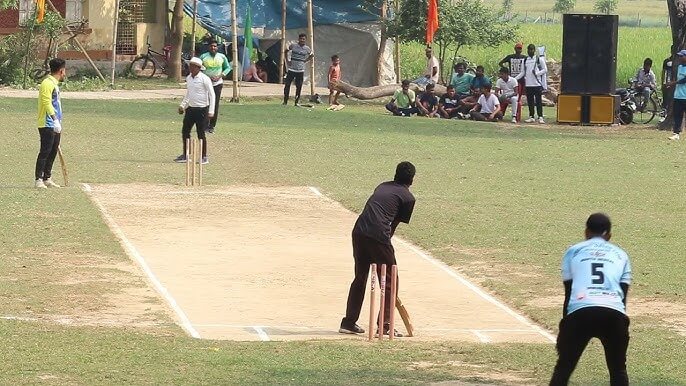
The tape ball cricket pitch dimensions used in organized competitions are not always exactly the same as the setup you see in a street, park, school ground, or local tournament. Tape ball cricket is commonly played in informal spaces, so the available area can influence the final setup. The England and Wales Cricket Board also describes tape ball as a format that can be played informally in many locations.
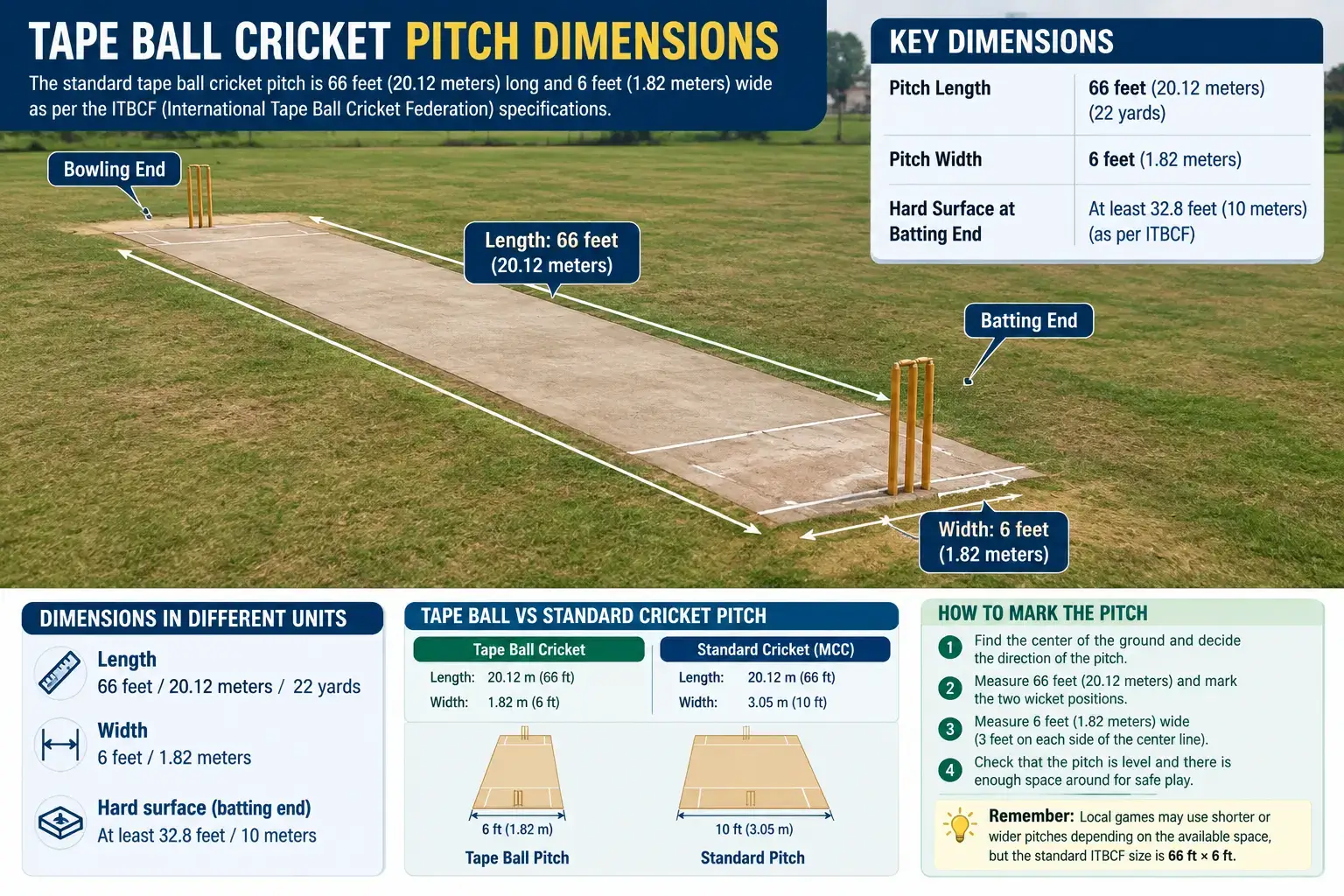
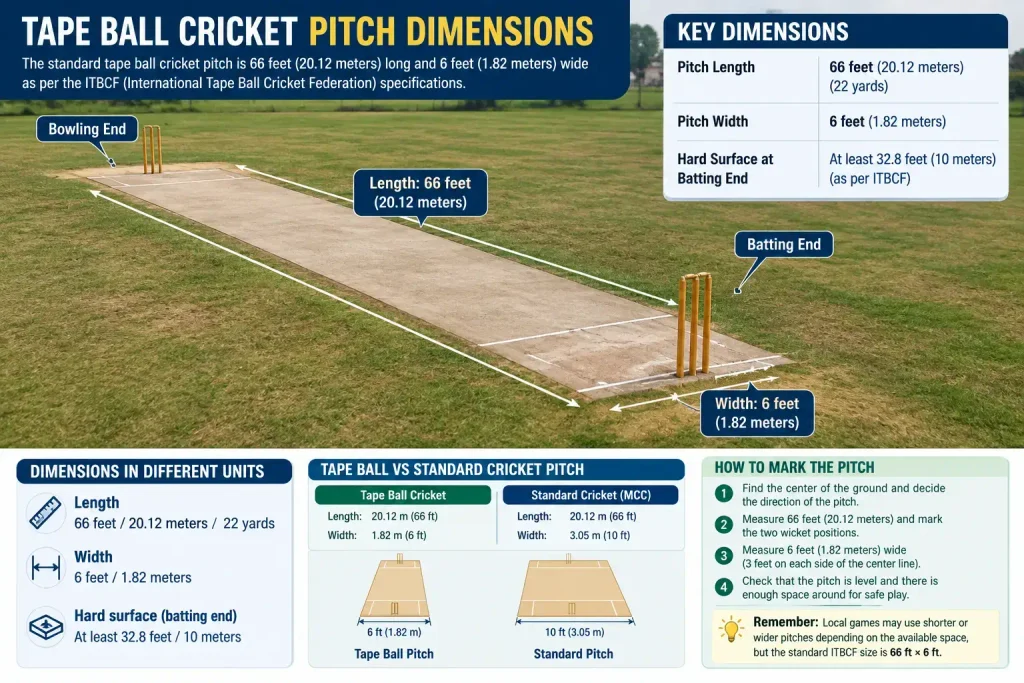
For an organized reference point, the International Tape Ball Cricket Federation (ITBCF) handbook specifies a pitch measuring 20.12 meters (66 feet) long and 1.82 meters (6 feet) wide.
What Are the Standard Tape Ball Cricket Pitch Dimensions?
According to the ITBCF handbook, the tape ball cricket pitch is:
| Measurement | Size |
|---|---|
| Pitch length | 20.12 meters / 66 feet |
| Pitch width | 1.82 meters / 6 feet |
| Hard surface required at batting end | At least 10 meters / 32.8 feet |
These measurements are useful when you are preparing a more formal tape ball cricket ground. The same handbook says officially recognized games use hard-surface pitches such as concrete, pavers, tarmac, or asphalt, although other surfaces can be considered with approval.
The important point is that the 66-foot length is not an arbitrary estimate. It is the pitch length specified in the ITBCF’s published handbook.
How Long Is a Tape Ball Cricket Pitch?
A tape ball cricket pitch is 20.12 meters or 66 feet long under the ITBCF standard.
That measurement is taken from one end of the pitch to the other, between the two sets of wickets.
For players who are more familiar with traditional cricket, 66 feet is also 22 yards. Standard cricket uses the same 22-yard length, although the standard cricket pitch is wider. MCC Law 6 defines a conventional cricket pitch as 22 yards (20.12 meters) long and 10 feet (3.05 meters) wide.
This is why you may hear someone say that a tape ball pitch is a 22-yard pitch, while another person gives the measurement as 66 feet.
Both describe the same length.
How Wide Is a Tape Ball Cricket Pitch?
The ITBCF handbook gives the tape ball pitch a width of 1.82 meters, or 6 feet.
This is narrower than a standard cricket pitch.
For comparison:
- Tape ball pitch width: 6 feet
- Standard cricket pitch width: 10 feet
The narrower tape ball setup helps create a compact playing area that suits the format and the types of grounds where tape ball cricket is commonly played.
It is also worth remembering that the pitch itself is only one part of the playing area. The outfield and boundary can extend considerably beyond it.
Tape Ball Cricket Pitch Dimensions in Feet
For anyone marking a ground with a measuring tape, the most useful numbers are:
Length: 66 feet
Width: 6 feet
If you are preparing the pitch yourself, mark the center line first and then measure 33 feet from the center in both directions to establish the full 66-foot length.
For the width, measure 3 feet on each side of the center line to create the 6-foot-wide playing strip.
This makes the layout easier to reproduce accurately instead of estimating the dimensions by eye.
Tape Ball Cricket Pitch Dimensions in Meters
Some grounds and tournament organizers prefer metric measurements.
The same ITBCF standard converts to:
Length: 20.12 meters
Width: 1.82 meters
The batting-end hard-surface requirement in the ITBCF handbook is at least 10 meters (32.8 feet).
If you are planning a new tape ball cricket ground, using metric measurements can make construction and marking easier, particularly when the available space is being measured professionally.
Is a Tape Ball Pitch the Same as a Normal Cricket Pitch?
Not exactly.
The length is the same as a standard adult cricket pitch at 20.12 meters (22 yards), but the ITBCF tape ball specification gives a narrower pitch width of 1.82 meters (6 feet). A standard cricket pitch is 3.05 meters (10 feet) wide under MCC Law 6.
There are also differences in how the games are played.
Tape ball cricket is built around a taped tennis ball and is often played in smaller or more flexible environments. The ECB notes that tape ball can be played informally in many locations and that the taped ball changes the way it swings and bounces.
That is one reason you should not automatically assume that every local tape ball match will have exactly the same ground dimensions.
Do All Tape Ball Grounds Use 66 Feet?
No.
This is one of the most important things to understand when searching for tape ball cricket pitch dimensions.
There is a difference between a published competition standard and informal local cricket.
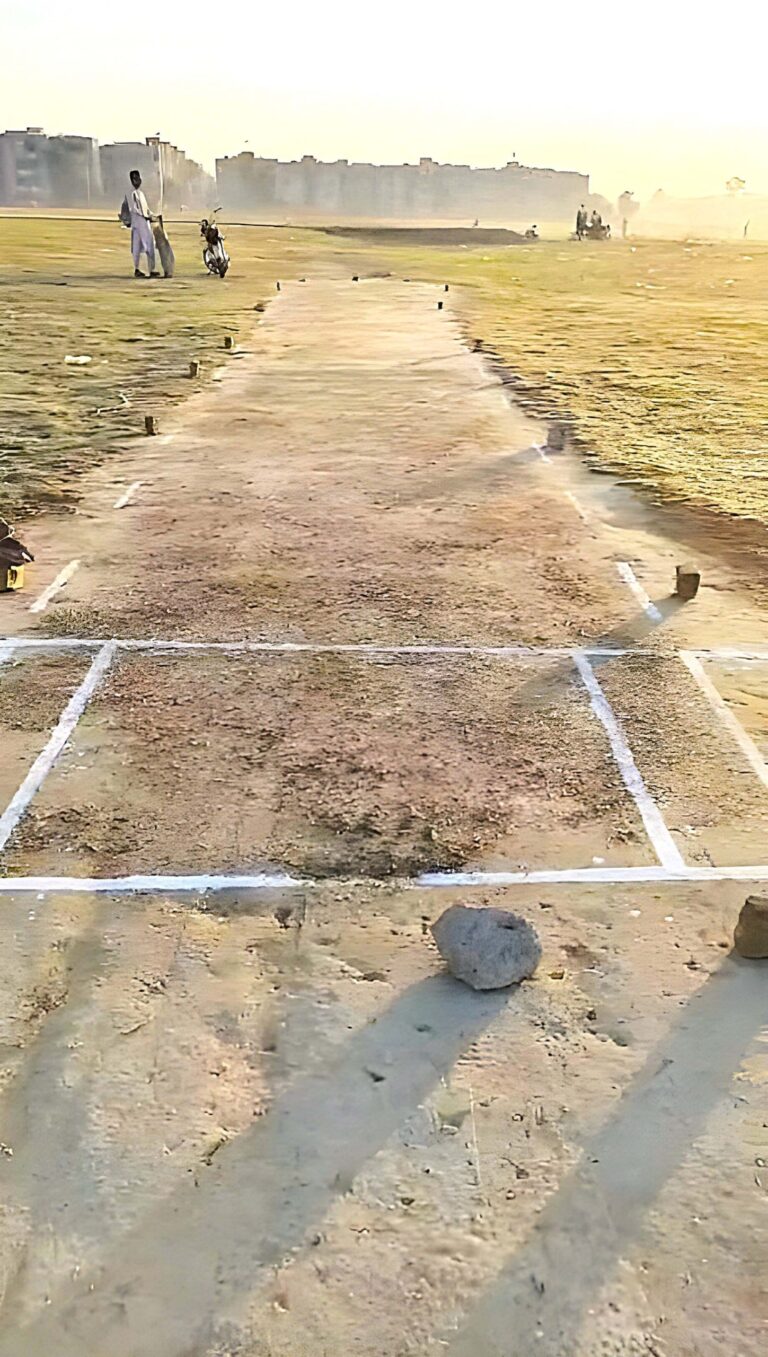
A tape ball match played in a neighborhood street, small park, school yard, or restricted ground may use a shorter pitch because the available space is limited. CricHeroes, for example, describes a roughly 20-yard pitch as typical while noting that the dimensions can vary depending on the available space.
So, if you are playing casually with friends, the pitch does not always need to be exactly 66 feet long.
However, if you are organizing a formal tournament and want a consistent playing setup, following the rules of the tournament or governing organization is more important than simply copying measurements from another local ground.
What Is the Best Pitch Length for Tape Ball Cricket?
For a formal setup, 66 feet (20.12 meters) is a strong reference because it is the pitch length specified by the ITBCF.
For casual cricket, the best length depends on the players and the available ground.
A shorter pitch can make the game feel faster because the batter has less time to react. It can also make fast bowling more difficult to handle.
A full-length 66-foot pitch gives players more room and keeps the setup closer to the dimensions used in organized cricket.
If you are preparing a pitch for regular competitions, keeping the measurement consistent from match to match is more important than constantly changing the length.
How to Mark a Tape Ball Cricket Pitch
You do not need expensive equipment to mark a basic tape ball pitch.
Start by finding the center of the playing area and deciding the direction of the pitch.
Measure 66 feet from wicket to wicket. Then mark the two wicket positions.
Next, measure the width. A 6-foot-wide pitch means the playing strip extends approximately 3 feet on either side of the center line.
After marking the pitch itself, check that there is enough room behind the wickets and around the playing area for batters, bowlers, fielders, and safe movement.
For organized matches, the ITBCF handbook also specifies that boundaries should be properly marked and visible.
How Much Ground Do You Need for a Tape Ball Pitch?
The pitch is only the central part of the ground.
You also need room for the outfield and boundary. The ITBCF handbook specifies a play area that can accommodate at least a 55-meter boundary toward deep cover extending toward long leg for a right-handed batter, while the remaining areas should have a minimum of 35 meters.
That is considerably larger than the pitch itself.
For a small local match, however, the actual boundary may be much shorter depending on the location and the tournament rules.
This is why it is important to separate pitch dimensions from overall ground or boundary dimensions.
What Surface Is Best for Tape Ball Cricket?
Tape ball cricket is played on many different surfaces.
The ITBCF handbook says an official playing area can include grass, dirt, artificial turf, or hard surfaces, while its officially recognized games are based on hard-surface pitches.
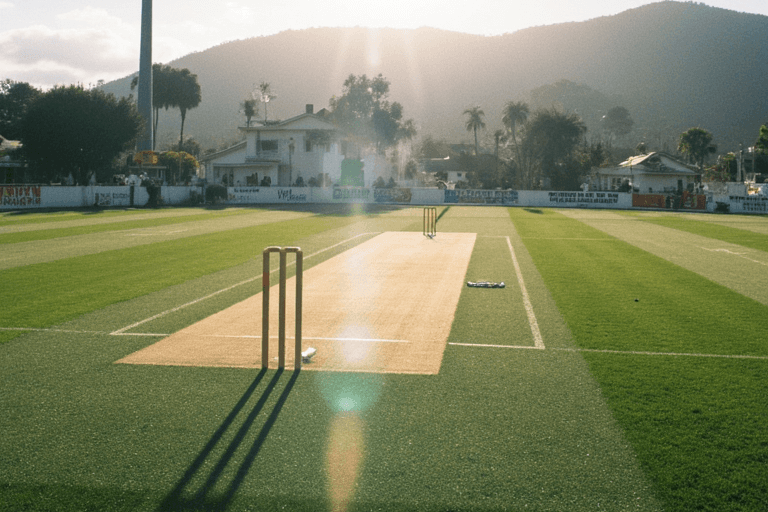
For local tape ball cricket, you may see pitches made from:
- Concrete
- Asphalt
- Pavers
- Artificial turf
- Compacted dirt
- Grass
The surface changes how the ball behaves. A hard surface can produce a quicker and more predictable bounce, while grass or rough dirt can introduce different bounce characteristics. The most important thing for a regular tournament is consistency. A pitch should not change dramatically from one match to another.
Why Pitch Dimensions Matter in Tape Ball Cricket
The size of the pitch directly affects how the game feels.
A shorter pitch generally gives the batter less reaction time, especially against fast bowling.
A longer pitch gives the batter more time to read the delivery and can create a different balance between bowling and batting.
Width also matters. A narrower pitch gives the bowler a more compact target area and can make line and length particularly important.
For tape ball cricket, where swing and bounce can be significant because of the taped tennis ball, even small differences in surface and distance can change the behavior of the delivery.
Tape Ball Cricket Pitch Measurements at a Glance
Here is the easiest way to remember the main measurements:
Pitch length: 66 feet / 20.12 meters / 22 yards
Pitch width: 6 feet / 1.82 meters
Hard surface at batting end: at least 32.8 feet / 10 meters under the ITBCF specification
Important: local matches may use different measurements depending on the available space and competition rules.
Tips for Setting Up a Tape Ball Cricket Ground
Before your first match, check a few practical things.
Make sure both wickets are directly opposite each other. Measure the distance instead of estimating it. Keep the pitch as level as possible. Uneven areas can produce unexpected bounce and make the match difficult to manage. Mark the boundary clearly so players know where the ball has gone for four or six. Remove stones, broken pieces of concrete, glass, or other dangerous objects from the playing area. If several matches will be played on the same ground, use the same measurements each time so teams are playing under comparable conditions. Most importantly, follow the specific tournament rules if your match is being organized under a particular association or competition.
Frequently Asked Questions
- What are the tape ball cricket pitch dimensions?
- The ITBCF handbook specifies a pitch 20.12 meters (66 feet) long and 1.82 meters (6 feet) wide.
- How long is a tape ball cricket pitch in feet?
- The standard reference length is 66 feet, which is the same as 22 yards or 20.12 meters.
- How wide is a tape ball cricket pitch?
- The ITBCF specification gives a width of 6 feet (1.82 meters).
- Is tape ball cricket pitch the same length as a normal cricket pitch?
- Yes, the 20.12-meter or 22-yard length is the same as the standard adult cricket pitch. The main difference here is width: the ITBCF tape ball specification is 6 feet wide, while the MCC standard cricket pitch is 10 feet wide.
- Can I play tape ball cricket on a shorter pitch?
- Yes. Informal tape ball cricket can be adapted to the available space, and different local matches may use different dimensions. For organized competitions, use the measurements specified by the tournament organizer or governing body.
- What is the best pitch length for a tape ball tournament?
- For a formal setup, 66 feet (20.12 meters) is a useful standard reference because it is specified by the ITBCF handbook. Tournament organizers should still follow their own published playing conditions.
Conclusion
Getting the pitch right is one of the simplest ways to create a better tape ball cricket match.
The main tape ball cricket pitch dimensions to remember are 66 feet (20.12 meters) in length and 6 feet (1.82 meters) in width under the ITBCF specification. For a neighborhood game, the available space may require a different setup. For a proper tournament, however, using consistent measurements helps every team play under the same conditions. Before marking your ground, measure the pitch carefully, position both wickets correctly, check the surrounding playing area, and make sure the boundary is clearly visible. Once the pitch is properly prepared, the rest of the match becomes much easier to organize.