Tape Ball Cricket Pitch Size in Pakistan: How Long and Wide Is It?
If you have played tape ball cricket in Pakistan, you already know that every ground does not look the same.One match might be played on a proper cricket ground with plenty of space behind the wickets. Another might be in a street where the bowler has barely enough room for a run-up. Some players use a full 22-yard distance, while others shorten it because the ground simply isn’t big enough.So when someone asks about the tape ball cricket pitch size in Pakistan, there isn’t always one simple answer.

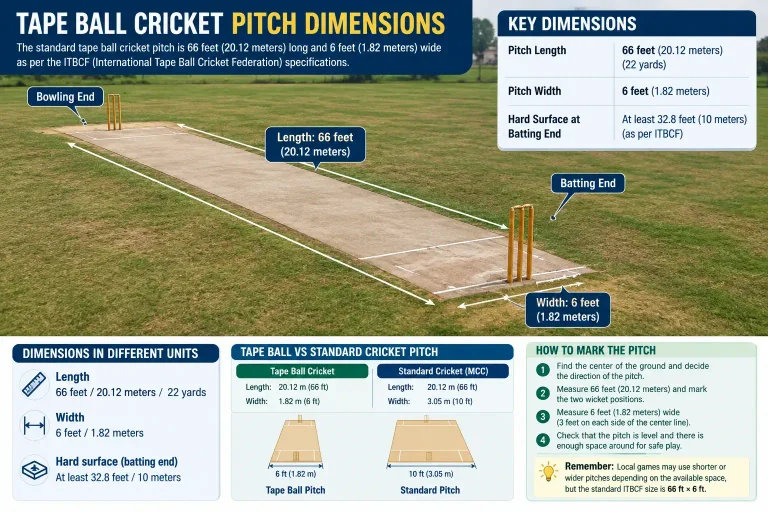
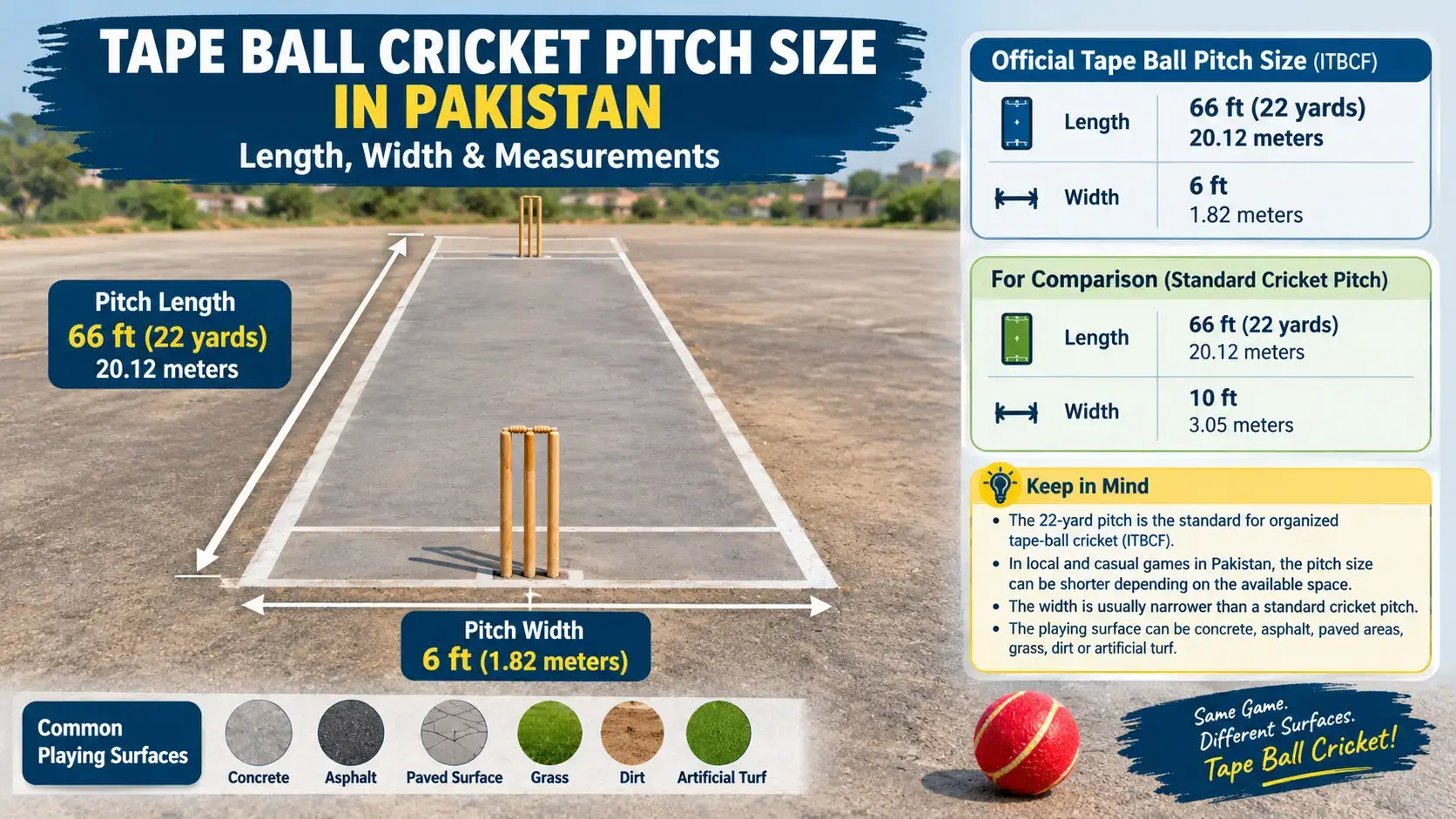
For an organized tape-ball setup, the pitch length is 22 yards (66 feet or 20.12 meters). The ITBCF tape-ball format specifies a pitch width of 6 feet (1.82 meters).But if you’re talking about the tape ball cricket most people actually play in Pakistan, things can be a little more flexible.
How long is a tape ball cricket pitch?
The standard distance is: 22 yards = 66 feet = 20.12 meters
In other words, if you’re setting up a proper 22-yard tape-ball pitch, you need roughly 66 feet from one set of wickets to the other.This is the same length used for a normal cricket pitch.That sometimes causes confusion. People assume that because the length is the same, a tape-ball pitch must be exactly the same as a regular cricket pitch. That’s not necessarily the case.The pitch width can be different, and the playing surface, ball and rules are also different.
For a recognized ITBCF tape-ball pitch, the specified width is 6 feet, or about 1.82 meters.
What does a 22-yard pitch look like in real life?
If you’ve never measured a cricket pitch yourself, 22 yards can be difficult to picture. It’s 66 feet from wicket to wicket.
The easiest way to set it up is to take a proper measuring tape to the ground and mark the two wicket positions. Don’t rely on counting steps if you want an accurate measurement. One person’s step can be noticeably longer than another person’s. This matters more in tape ball cricket than some people realize. A few yards can change the whole feel of a game. A fast bowler coming from a shorter distance gives the batter less time to react, while a full-length pitch gives the bowler more room to build up speed.
That’s why a tape-ball match played on a short street pitch can feel completely different from one played on a proper ground.
What is the width of a tape ball cricket pitch?
For the ITBCF format, the pitch is 6 feet wide (1.82 meters).
For comparison, a conventional cricket pitch is generally 10 feet wide (3.05 meters).
So while both can be 22 yards long, they don’t necessarily have the same width.In casual tape-ball cricket, though, you may not see players measuring the width down to the inch. In many local games, the pitch is simply marked according to the space available.The length between the wickets usually gets more attention because that is what directly affects the bowling distance.
Why don’t all tape ball pitches in Pakistan have the same size?
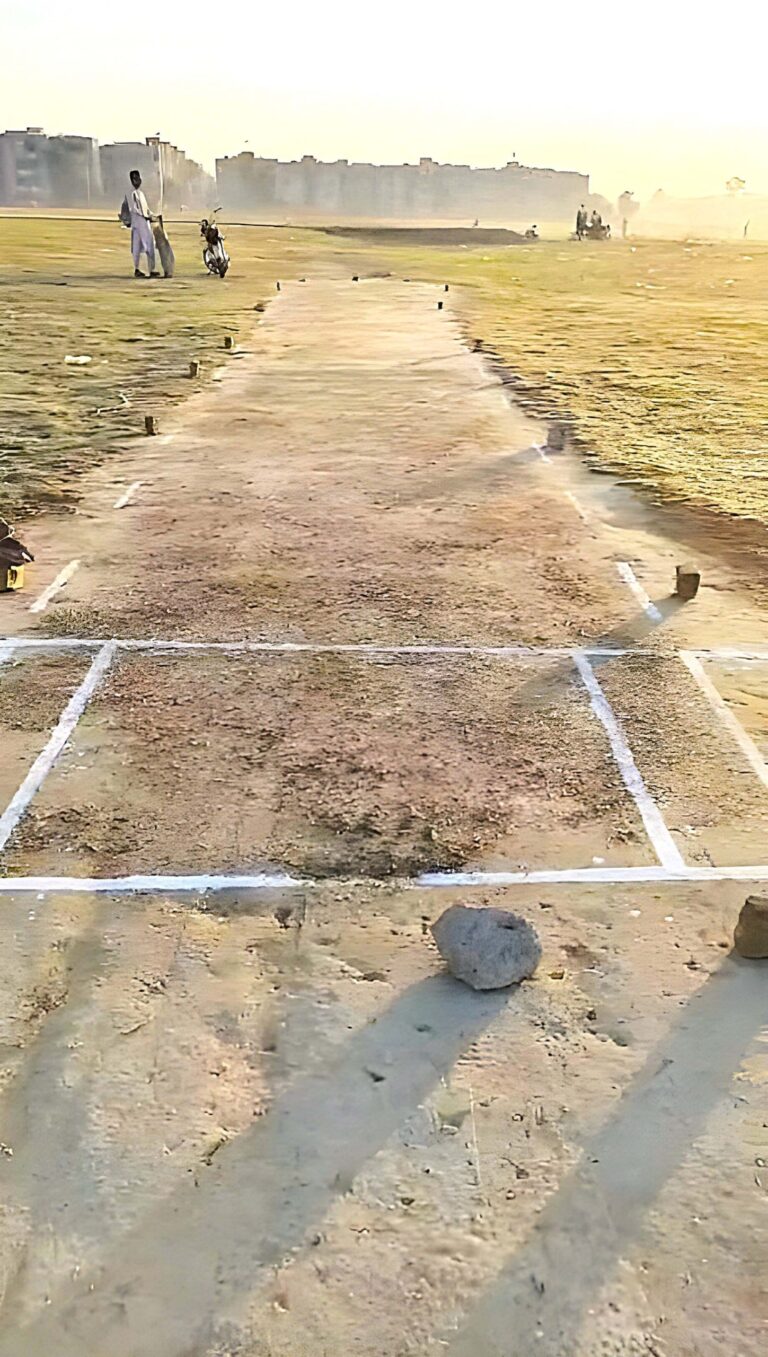
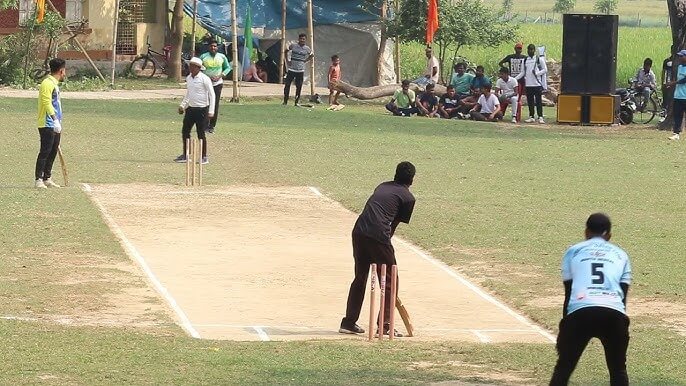
This is probably the most important thing to understand about tape-ball cricket in Pakistan.Tape ball cricket wasn’t built around expensive stadiums or specially prepared grounds. One of its biggest attractions is that you can play it almost anywhere with enough room. A group of friends can set up a game in a park. Another group might play on a school ground. Some players play on concrete or asphalt, while others find an open patch of ground and make their own pitch.
If there is enough room, they can use 22 yards. If there isn’t, they shorten it.
Nobody playing a casual evening match is going to stop the game because the pitch is 18 or 20 yards instead of 22. The players normally agree on the distance and get on with the game. That’s one of the things that makes tape-ball cricket different from formal cricket.
Can you play tape ball cricket on a shorter pitch?
Yes. A shorter pitch is common when the available playing area is limited. It can also make sense when children or less experienced players are playing.
But there is a trade-off. Move the bowler closer to the batter and the ball reaches the crease faster. For a fast bowler, that can make the delivery feel much quicker. The batter gets less time to pick up the ball and react.
This is particularly noticeable with a hard, tightly taped tennis ball coming off a concrete or asphalt surface. So if your local tape-ball match is being played on a shorter pitch, don’t be surprised if the game feels faster than one played on a full 22-yard pitch.
What surface is used for tape ball cricket?
This is another area where tape ball cricket is very different from traditional cricket. You don’t necessarily need a grass cricket pitch.
In Pakistan, tape-ball matches can be played on concrete, asphalt, paved areas, artificial turf, dirt or grass, depending on where the players have found space.
The surface makes a big difference. A smooth concrete surface can make the ball skid and travel quickly. An uneven surface can produce an awkward bounce. A cracked or damaged area can also make the game uncomfortable and potentially unsafe.
Before starting a match, it is worth taking a few minutes to look over the playing area. A small stone might not look important when you’re standing next to it. It can be a very different story when a batsman or bowler lands on it at full speed.
How to measure a tape ball pitch
If you’re preparing a proper 22-yard pitch, you don’t need anything complicated.
Take a measuring tape and measure 66 feet (20.12 meters) between the two wicket positions.
Mark both ends clearly.
Then allow enough room around the pitch for the bowler’s run-up and for the players to move safely.
If you’re following the ITBCF dimensions, the pitch itself should be around 6 feet wide.
For a local match, the exact setup can be agreed between the teams before the first ball.
The important part is consistency. If one team bowls from 22 yards and the other gets a different distance, the match obviously isn’t going to feel fair.
What about the boundary?
Don’t confuse the pitch measurement with the boundary.
They are two separate things.
You can have a 22-yard pitch with a relatively small boundary, or you can have the same pitch inside a much larger ground.
This is another reason tape-ball cricket can vary so much from one location to another. A six in a small street can require very different power compared with a six on a large open ground. Local organizers normally set the boundary according to the space available and whatever rules they have agreed for the match.
Tape ball pitch size vs normal cricket pitch
Here is the simple comparison:
| Tape Ball Pitch | Standard Cricket Pitch | |
|---|---|---|
| Length | 22 yards / 66 ft | 22 yards / 66 ft |
| Length in meters | 20.12 m | 20.12 m |
| Width | 6 ft / 1.82 m* | 10 ft / 3.05 m |
| Ball | Taped tennis ball | Leather cricket ball |
| Surface | Often hard or artificial | Usually prepared cricket surface |
*The 6-foot width refers to the ITBCF tape-ball format. Local games can use different dimensions.
So the biggest difference isn’t necessarily the length.
The game itself is different because of the ball, surface, rules, boundary and style of play.
What size should you use for your own tape ball match?
If you’re organizing a proper tournament or want everyone to play under consistent conditions, 22 yards (66 feet) is a sensible measurement to use.
If you’re just playing with friends in a small area, use the space you have. There is no point trying to squeeze a full-size pitch into a place that clearly doesn’t have enough room. Measure the available area, agree on the bowling distance, mark it properly and make sure both teams know the rules before the match starts.
For younger players, a shorter distance can also be more practical.
The goal is to create a pitch that is playable and safe, not simply to chase a number.
Quick answer
If you’re looking for the basic answer, here it is:
A recognized tape ball cricket pitch is 22 yards (66 feet or 20.12 meters) long and 6 feet (1.82 meters) wide under the ITBCF format.
In everyday tape-ball cricket across Pakistan, however, the pitch can be shorter or slightly different depending on the ground and local rules. That’s why you may see different measurements when you visit different tape-ball grounds.
Frequently Asked Questions
- Is a tape ball cricket pitch 22 yards?
- Yes. The recognized tape-ball format uses a 22-yard (66-foot) pitch. Informal games can use a shorter distance when space is limited.
- How many feet is a tape ball cricket pitch?
- A 22-yard pitch is 66 feet long.
- How wide is a tape ball cricket pitch?
- The ITBCF tape-ball format specifies a width of 6 feet (1.82 meters).
- Can tape ball cricket be played on an 18-yard pitch?
- Yes. Local tape-ball games can use shorter pitches when the playing area is small. The teams should agree on the distance before playing.
- Is a tape ball pitch the same length as a cricket pitch?
- Yes, both can be 22 yards long, although their width, surface and playing conditions can be different.
- What is the best length for tape ball cricket?
- For an organized match, 22 yards gives you a consistent full-length setup. For casual games, the right distance depends on the available space and the players.
conclusion
There isn’t one pitch sitting in every corner of Pakistan with exactly the same measurements. That’s part of the character of tape-ball cricket. The recognized 22-yard setup gives organizers a useful standard: 66 feet long and 6 feet wide under the ITBCF format. But take the game to a small ground, a street or a local park and you’ll often find players adapting the pitch to whatever space they have. And honestly, that’s one of the reasons tape ball cricket has become such a big part of cricket culture in Pakistan.
You don’t need a perfect cricket stadium. You need a ball, a bat, a few players, enough space to bowl, and a pitch everyone agrees on. If you’re setting up a proper tape-ball ground, start with the 22-yard measurement, mark it carefully, check the surface and set the boundaries according to the available space. Once everything is ready, the only thing left is to pick up the ball and start playing.